
Telegram Ads Targeting: A Practical Guide for 2026

Last updated: November 2026
Telegram Ads targeting works by layering selections for public channels, topics, user languages, and locations to define where your sponsored message appears. Unlike platforms that build psychographic profiles, Telegram's system is primarily contextual, focusing on the environment where the user sees the ad, not who the user is individually.
This guide explains the mechanics of each targeting option available on the Telegram Ad Platform. It details how they combine and outlines strategies for both precision and scale. For marketers accustomed to Meta or Google's ad platforms, understanding these differences is the first step to running efficient campaigns on Telegram, which now has a massive and engaged user base.
Over 1 Billion Monthly Active Users: In March 2025, Telegram officially crossed the one-billion monthly active user threshold, making it one of the largest communication platforms globally. (Telegram Blog, 2025)
Understanding the Core Targeting Layers in Telegram Ads
Telegram's advertising system has evolved from simple channel placements to a more layered model. An effective telegram ads targeting strategy requires understanding how each layer functions and interacts. The platform's logic is subtractive: every new criterion you add narrows your potential audience.
Channel Targeting
This is the most granular form of targeting. You hand-pick specific public channels where you want your ad to run. This method offers maximum control but requires significant research. Your ad will only appear in channels with more than 1,000 subscribers. Success here depends on analyzing a channel's content, audience engagement, and topical relevance to your offer. It is the preferred method for niche products where the audience congregates in known communities.
Topic Targeting
Instead of picking individual channels, you can target broad topics like "Crypto," "News," "Fashion," or "Technology." Telegram uses its own algorithms to classify channels into these categories. This approach provides much greater scale and reach than targeting individual channels. However, it sacrifices precision. Your ad could appear in any channel that Telegram deems relevant to the topic, so it's important to use exclusion lists to maintain brand safety.
Language and Location Targeting
These layers filter users within your selected channels or topics.
- Language Targeting: Filters users based on the language setting of their Telegram app. For example, you can target a large international crypto channel but only show your ad to users who have their app set to Spanish.
- Location Targeting: Allows you to target users based on their country or sometimes specific cities. This is based on signals like IP address. It is not as precise as GPS-based location targeting on other platforms but is effective for country-specific offers.
Excluding Topics and Channels
Negative targeting is a critical tool for budget efficiency. You can create lists of specific channels or entire topics to exclude from your campaign. This prevents your ad from appearing in competitor channels, irrelevant communities that happen to be in your target topic, or channels with content that conflicts with your brand values.
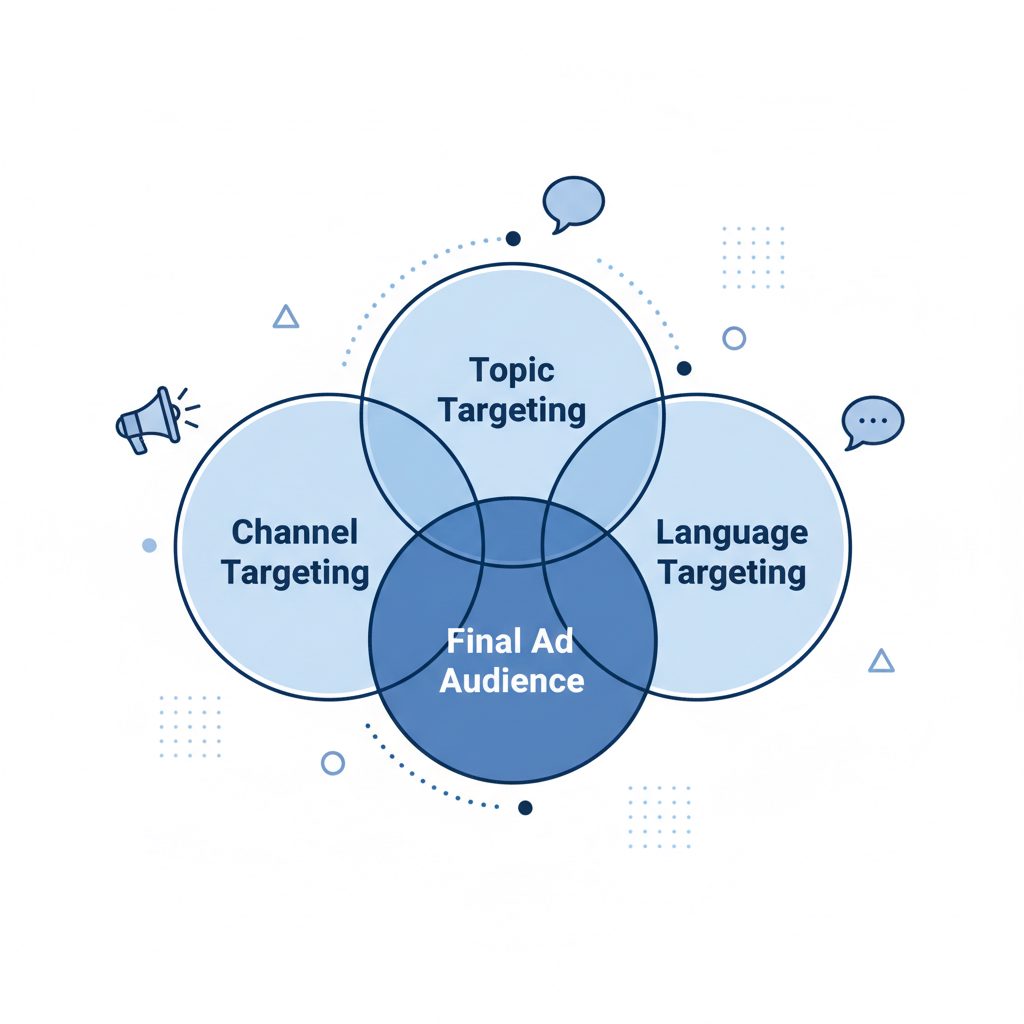
How Targeting Layers Combine: The "AND" Logic
A common point of confusion for new advertisers is how these layers interact. Telegram uses "AND" logic, meaning each condition you add makes your audience smaller and more specific. The ad will only be shown to users who meet all the criteria simultaneously.
For example, if you set up a campaign with the following parameters:
- Topics:
Finance - Languages:
English - Locations:
United Kingdom
Your ad will only be shown to users in channels categorized under Finance AND who have their Telegram app set to English AND who are located in the United Kingdom. Adding a specific channel target would further restrict it to users who meet the language and location criteria within that specific channel.
A well-defined targeting strategy on Telegram is not about finding the perfect user, but about finding the perfect context. The platform's design forces advertisers to focus on channel quality and content alignment over invasive user tracking.
Telegram Ads Targeting Options Compared
| Targeting Type | What It Controls | Best For... | Common Pitfall |
|---|---|---|---|
| Specific Channels | Exact placement in chosen public channels. | Niche products, B2B, high-value offers. | Limited scale; requires extensive channel research. |
| Topics | Placement across a broad category of channels. | Brand awareness, app installs, mass-market CPG. | Low precision; risk of brand-unsafe placements. |
| Languages | Filters users by their app's language setting. | Localized campaigns, multilingual markets. | Misjudging the primary language of a channel's audience. |
| Location (Country/City) | Filters users by their geographic location. | Geo-fenced offers, local services, compliance. | Less granular than other platforms; based on IP. |
| Exclusions | Prevents ads from appearing in specific channels/topics. | Budget efficiency, brand safety, avoiding competitors. | Not creating a comprehensive enough exclusion list. |
Choosing Your Targeting Strategy: Precision vs. Scale
Your business goals should dictate your targeting strategy. The two primary paths are precision and scale, and they serve different objectives.
The Precision Strategy involves hand-picking a small list of 10-50 highly relevant channels. This is ideal for high-ticket services, B2B software, or niche communities where you know exactly where your target customer spends their time. The cost per mille (CPM) may be higher due to competition for these valuable slots, but the return on ad spend (ROAS) is often superior due to higher conversion rates. This approach demands meticulous research into each channel's audience quality and engagement patterns.
The Scale Strategy uses broad Topic targeting to maximize reach. This is effective for mobile app installs, e-commerce stores with wide appeal, or major brand awareness campaigns. CPMs are generally lower, but click-through rates (CTR) and conversion rates can also be lower. Success with this strategy depends on having a compelling, universally understood offer and using aggressive exclusion lists to weed out low-performing or irrelevant channels.

Where TgFather's Telegram Ads Service Fits
Telegram's official ad platform is open to anyone, with ads paid in Toncoin and a minimum CPM of 0.1 TON (Telegram Ads). The real barriers are practical: funding a Toncoin wallet, passing ad review and finding the time to manage campaigns.
This is where an agency model provides a solution. TgFather's Telegram Ads service allows businesses to run official Sponsored Messages without meeting this high financial threshold. We act as a managed service, pooling client funds to meet Telegram's requirements. This gives small and medium-sized businesses, marketing agencies, and individual advertisers access to the same powerful targeting tools for a fraction of the entry cost.
This service is for clients who want to run official campaigns with a USD budget plus a flat 10% fee, paid from a crypto wallet. Clients write the ad in a builder with a live preview and choose targeting, and our team files and manages the campaign on the official platform. Teams that prefer full control can open their own account on ads.telegram.org; older guides describe a €2 million direct partnership, but that is not required today (clickspero.com).
Checklist for a Successful Targeting Setup
Before launching any campaign, follow this process to maximize your budget and results.
- Research Channels: Identify at least 50 public channels that appear relevant to your audience. Use Telegram's built-in search and third-party analytics tools.
- Qualify Channels: Manually review your top 20 candidates. Look for active discussions, low bot presence, and content that aligns with your brand. A channel with 20,000 real, engaged members is better than one with 200,000 passive subscribers.
- Define Core Filters: Decide on your mandatory language and location targets. If your product is only available in Germany, this is a non-negotiable first filter.
- Build Exclusion Lists: Create a list of specific channels (like your direct competitors) and topics (like "Politics" or "Gambling") you want to avoid at all costs.
- Align Ad Copy: Write ad copy that speaks the language of your target channels. A formal tone might work for a finance channel, but it will fail in a community built on memes.
- Test and Measure: Start with a small budget focused on your top 5-10 channels. Measure CPM and CTR to establish a baseline before expanding to broader Topic targeting or a larger channel list. You can learn more about the different ways to buy Telegram Ads through various providers.
- Consider an Agency: If the research and management feel overwhelming, working with a Telegram ads service provider can streamline the entire process.
Frequently Asked Questions
How much do Telegram ads cost?
Telegram ads are sold on a CPM (Cost Per 1,000 Impressions) basis, with a minimum bid of 0.1 TON, but the final cost increases based on competition for specific channels or topics (newage.agency). Beyond the ad spend itself, the main cost is the time to set up and manage campaigns, which an agency can take on.
Can I target specific users on Telegram?
No. You cannot target individual users. Telegram Ads targeting is contextual and demographic, not personal. It focuses on the channel's topic, and the user's set language and general location, preserving user privacy by design.
What's the difference between Topic and Channel targeting?
Channel targeting is precise; you select specific, named channels. Topic targeting is broad; you select a category like "Technology," and Telegram shows your ad in numerous channels it classifies under that topic. You trade control for reach.
Can I target my competitor's Telegram channel?
Yes. If your competitor's channel is public and has over 1,000 subscribers, you can include it in a "Specific Channels" targeting list. Your sponsored message will appear at the bottom of their feed for users who meet your other criteria.
How does Telegram know a user's location or language?
Language is determined by the user's language setting within the Telegram application itself. Location is an approximation based on the user's IP address and is not as granular as GPS data used by other mobile apps, typically resolving to the country or major city level.